TL;DR
Red light therapy home devices are one of the fastest growing skincare categories of 2026 — masks, wands, and panels are everywhere, and the clinical-sounding marketing behind them has convinced a lot of people they’re getting something close to a professional treatment. They’re not, and understanding why matters if you’re making decisions about how to invest in your skin. This piece explains how LED therapy actually works, what separates a clinical treatment from an at-home device, and when each one makes sense.
In this article
Who This Is For
Anyone who owns a home red light device and is wondering whether a professional LED session would add anything meaningful. Also for anyone considering buying one and trying to work out whether it’s worth the investment, and for clients at Fresh Skin who receive LED therapy as part of their treatment programme and want to understand what it’s doing and why.
How LED Therapy Actually Works
LED therapy uses specific wavelengths of light to penetrate the skin at different depths and trigger biological responses in the tissue. The mechanism is called photobiomodulation — light energy is absorbed by chromophores in the skin cells, which stimulates the mitochondria to produce more ATP (adenosine triphosphate, the cell’s energy currency), accelerating cellular repair, reducing inflammation, and promoting collagen synthesis.
Different wavelengths target different things. Red light (around 630-660nm) penetrates to the dermis and stimulates fibroblast activity and collagen production. Near-infrared light (around 810-850nm) penetrates deeper into the tissue and is particularly effective for inflammation reduction, wound healing, and cellular repair. Blue light (around 415-445nm) targets the sebaceous glands and kills the P. acnes bacteria that contributes to breakouts. Professional LED devices typically combine multiple wavelengths within a single session, calibrated to the specific concern being addressed.
A 2014 study published in Photomedicine and Laser Surgery by Wunsch and Matuschka examined the effects of red and near-infrared LED light therapy on skin rejuvenation and found statistically significant improvements in complexion, skin texture, and collagen density compared to control groups. The key variable in the study was the consistent dosing of light energy — something that professional devices are specifically engineered to deliver and that most home devices cannot reliably replicate.
The Honest Difference Between Clinic and Home
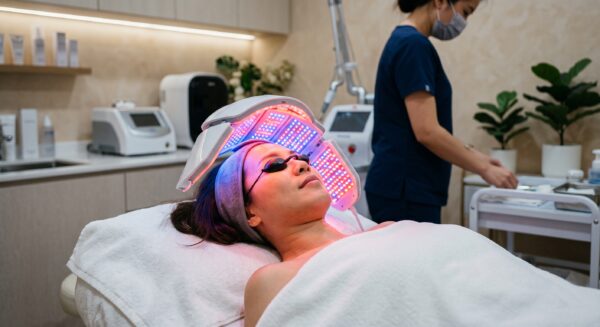
Fresh Skin uses the Healite II LED therapy system — a clinical-grade device that delivers targeted red, near-infrared, and blue wavelengths at irradiance levels meaningfully higher than consumer devices. The gap isn’t primarily about the technology itself — it’s about power, penetration depth, and treatment consistency.
Clinical LED devices deliver significantly higher irradiance (the measure of light energy per unit area) than consumer devices, which are power-limited for safety reasons related to unsupervised use at home. Higher irradiance means more photons are reaching the target tissue per session, which determines how significant the biological response is. A home device used regularly will produce some benefit for surface concerns like mild inflammation, redness, and general skin quality — that’s real, and worth acknowledging. But the degree of cellular stimulation, and particularly the depth at which collagen-related changes can be driven, is meaningfully different at clinical irradiance levels.
Wavelength precision is the second variable. Professional devices deliver light at highly specific, calibrated wavelengths that correspond to the peak absorption spectra of the target chromophores. Consumer devices often deliver wavelengths in a broader range around the target, which reduces the efficiency of absorption and the consistency of the biological response. This matters most when the goal is collagen stimulation or deep tissue inflammation reduction rather than surface skin quality improvement.
When Home Devices Make Sense
I’m not going to tell you home red light devices are pointless, because that’s not accurate and it’s not helpful. For maintaining skin quality between professional treatments, managing mild and ongoing redness, supporting skin barrier recovery after active skincare, and keeping the skin in a generally good state of cellular activity, a consistent home device routine adds genuine value. The key word is consistent — the benefit of home devices is cumulative and depends entirely on regular use, which is where most people eventually trail off.
They’re also useful for clients who’ve had professional treatments and want to extend the benefit between sessions. A home device won’t replicate a clinic treatment, but used in the recovery period following RF microneedling or microneedling, it supports the healing response and can meaningfully extend how long results last.
Where Professional LED Fits in a Treatment Programme
At Fresh Skin, LED therapy works most powerfully alongside other treatments rather than in isolation. Post-treatment LED following Sylfirm X RF microneedling accelerates the recovery phase, reduces post-treatment redness and inflammation, and supports the collagen response that the RF energy has triggered.
The same applies after microneedling — the skin is in an active repair state and LED therapy at that point supports the biological process already underway rather than adding a separate stimulus on top of it. The combination is one of the reasons Fresh Skin regularly pairs LED with other treatments in a single session or a structured programme.
As a standalone regular treatment, LED works well for clients whose primary concern is ongoing skin quality, redness management, or maintaining results between more intensive sessions. It pairs particularly well alongside Hydrafacial for clients who want a hydration-focused maintenance programme, because the two treatments work at complementary layers — Hydrafacial addressing surface hydration and exfoliation while LED supports deeper cellular activity.
What LED won’t do is address structural concerns like laxity, significant pigmentation, or acne scarring as a primary treatment. The biology is focused on cellular activity, inflammation, and collagen support — it’s not a resurfacing or lifting modality. Part of a well-designed treatment plan is being clear about which tool is doing which job, and LED is a recovery and maintenance tool rather than a primary corrective one for most concerns.
A Closing Thought
The red light therapy trend has done something useful in making people aware that light-based treatments have clinical applications beyond aesthetics. The frustrating part is that the home device marketing has somewhat blurred the line between what a consumer product can deliver and what a clinical treatment provides, and people are making purchasing decisions without a clear picture of the difference.
The honest answer is: both have a place, they serve different purposes, and understanding that distinction means you can use both more intelligently rather than expecting one to replace the other. A home device won’t replace a clinic treatment. A clinic treatment doesn’t make a home device redundant. They sit at different points in a skin programme, and knowing where each one fits is more useful than choosing between them.
If you’d like to understand where LED fits into your specific skin programme, the best starting point is a skin consultation at Fresh Skin. You can also explore the full range of treatments to see how LED works alongside everything else we offer.
Jodie Orford is the owner and Director of Fresh Skin Clinic Perth, and the founder of Pilates Principles studios in Ardross and Claremont.