TL;DR
The age at which people start thinking seriously about skin treatments is shifting. Where Fresh Skin’s client base has traditionally sat in the 40-70 bracket, we’re seeing a clear and consistent move toward women in their mid-to-late thirties booking in for their first RF microneedling or HIFU consultation. This isn’t vanity creep. It’s a smarter approach to skin ageing — one that the clinical evidence has been pointing toward for years. This piece looks at why early intervention makes biological sense, what that actually looks like in practice, and whether you’re at the stage where it’s worth considering.
In this article
Who This Is For
Women in their thirties who have started noticing something different about their skin — a loss of firmness through the jawline, fine lines that weren’t there two years ago, or a general shift in how their skin sits and behaves — and who aren’t sure whether they’re at the stage where professional treatment is appropriate or whether they’re just being premature. You’re probably not being premature. The biology of why will make sense by the end of this piece.
The Collagen Timeline Nobody Talks About
Here’s the part that changes how most people think about skin ageing. Collagen production doesn’t gradually slow as you age and then suddenly stop somewhere in your fifties. It begins declining meaningfully in your late twenties, at roughly one percent per year, and by the time visible changes appear on the surface of the skin, significant structural loss has already occurred beneath it. What you see in the mirror in your late thirties is the visible result of a decade of slower collagen production, not the beginning of the process.
This matters for treatment decisions because collagen stimulating treatments work with what you have. They trigger the body’s own repair response, producing new collagen to rebuild the framework that’s been depleting. When that framework is still relatively intact, the response is stronger and the results are more pronounced. Treating earlier doesn’t mean treating unnecessarily — it means treating when the investment is most likely to pay off.
A 2015 study published in the Journal of Cosmetic Dermatology by El-Domyati et al. assessed histological changes in collagen and elastin following microneedling treatment and documented significant increases in collagen type I, collagen type III, and fibronectin in the dermis after treatment. The measurable improvement was consistent across patients, but the degree of baseline collagen density influenced the extent of response — which is the clinical argument for earlier intervention before that baseline has depleted significantly.
What’s Actually Changed About the 35-40 Age Group
Part of this shift is generational awareness. The women coming into Fresh Skin in their mid-thirties now grew up watching their mothers and older sisters navigate skin ageing, and many of them have already been using retinoids, SPF, and targeted actives for years. They have a reasonably sophisticated understanding of what’s happening to their skin and they’re not waiting for things to get dramatically worse before addressing them.
There’s also a cultural shift away from the “I’ll deal with it later” approach to ageing that dominated the previous generation’s thinking. The overly augmented look that characterised early 2010s aesthetics has left a strong impression on younger women, and most of them have a very clear idea of what they don’t want. They’re interested in maintaining what they have, not dramatically altering how they look.
That instinct maps well onto what treatments like Sylfirm X and microneedling actually deliver — gradual, consistent improvement in skin quality, texture, and early laxity that reads as looking well and healthy rather than having had something done. The results are subtle precisely because they’re working with the skin’s own processes rather than overriding them.
Which Treatments Make Sense at This Stage
Not every treatment in Fresh Skin’s range is equally well-suited to the thirties age group, and part of what we do in a consultation is work out which tools are actually appropriate for where someone’s skin is right now rather than applying the same programme regardless.
Collagen induction therapy through microneedling is often a good starting point — it’s a proven treatment with a well-established evidence base, suits most skin types, and works well as both a standalone treatment and as part of a broader programme. It addresses fine lines, texture, and the very early stages of skin laxity that many women in their thirties are beginning to notice.
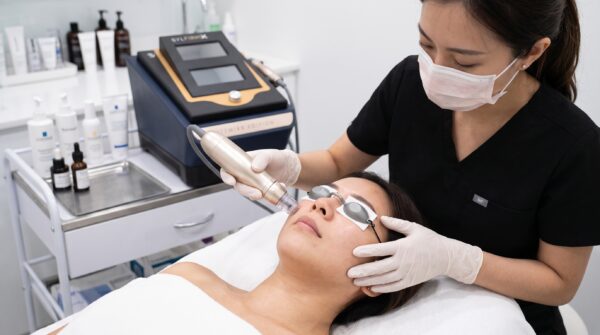
For clients with specific concerns around early laxity, pigmentation, or redness, Sylfirm X RF microneedling provides a more targeted stimulus at a deeper dermal level, using pulsed and continuous radiofrequency energy to address multiple concerns in the same session. It tends to produce more pronounced results for skin quality concerns and is particularly useful when pigmentation or redness is part of the picture alongside early ageing.
For clients with sensitive skin or those who want a lower-intensity starting point, Procell microchannelling sits at the gentler end of the range. The growth factor infusion delivered through fine microchannels supports cellular repair and collagen production without the thermal energy component of RF microneedling — making it a strong option for skin that needs stimulation but responds better to a more careful approach.
For completeness: HIFU is generally a conversation for the early-to-mid forties rather than the thirties, because the structural laxity it addresses at the SMAS layer is typically not yet present in younger skin. I’d rather tell someone that honestly at consultation than recommend a treatment that isn’t well-matched to where their skin actually is.
The Sunscreen Conversation
No piece about early skin intervention in Perth is complete without this. If there is one non-negotiable habit that changes the long-term trajectory of skin ageing in a high-UV climate, it’s daily broad-spectrum SPF 50. Not for beach days. Every day, year round, regardless of cloud cover. The UV index in Perth sits at moderate to high for nine to ten months of the year, and UV exposure is the single most significant environmental driver of collagen degradation and photoageing.
The most effective early intervention isn’t a treatment. It’s protection. Everything else builds on that foundation, and without it, no amount of professional treatment will fully offset the damage accumulating between appointments.
A Closing Thought
What I find most interesting about this shift toward earlier treatment is that it reflects a more honest understanding of how skin ageing actually works. Waiting until change is dramatic before addressing it was never the most sensible approach — it just used to be the accepted one. The women coming in now in their thirties aren’t overcorrecting. They’re being realistic about biology.
That’s a conversation Fresh Skin is very comfortable having, and the team will always tell you what stage your skin is actually at rather than what treatment would be most convenient to recommend.
The best starting point is a full skin consultation — it gives the team an accurate read on where your skin actually is and what treatment, if any, makes sense right now. You can also explore the full Fresh Skin treatment range to see everything we offer before you come in.
Jodie Orford is the owner and Director of Fresh Skin Clinic Perth, and the founder of Pilates Principles studios in Ardross and Claremont.